打造你的第一个 7x24 Agent 循环

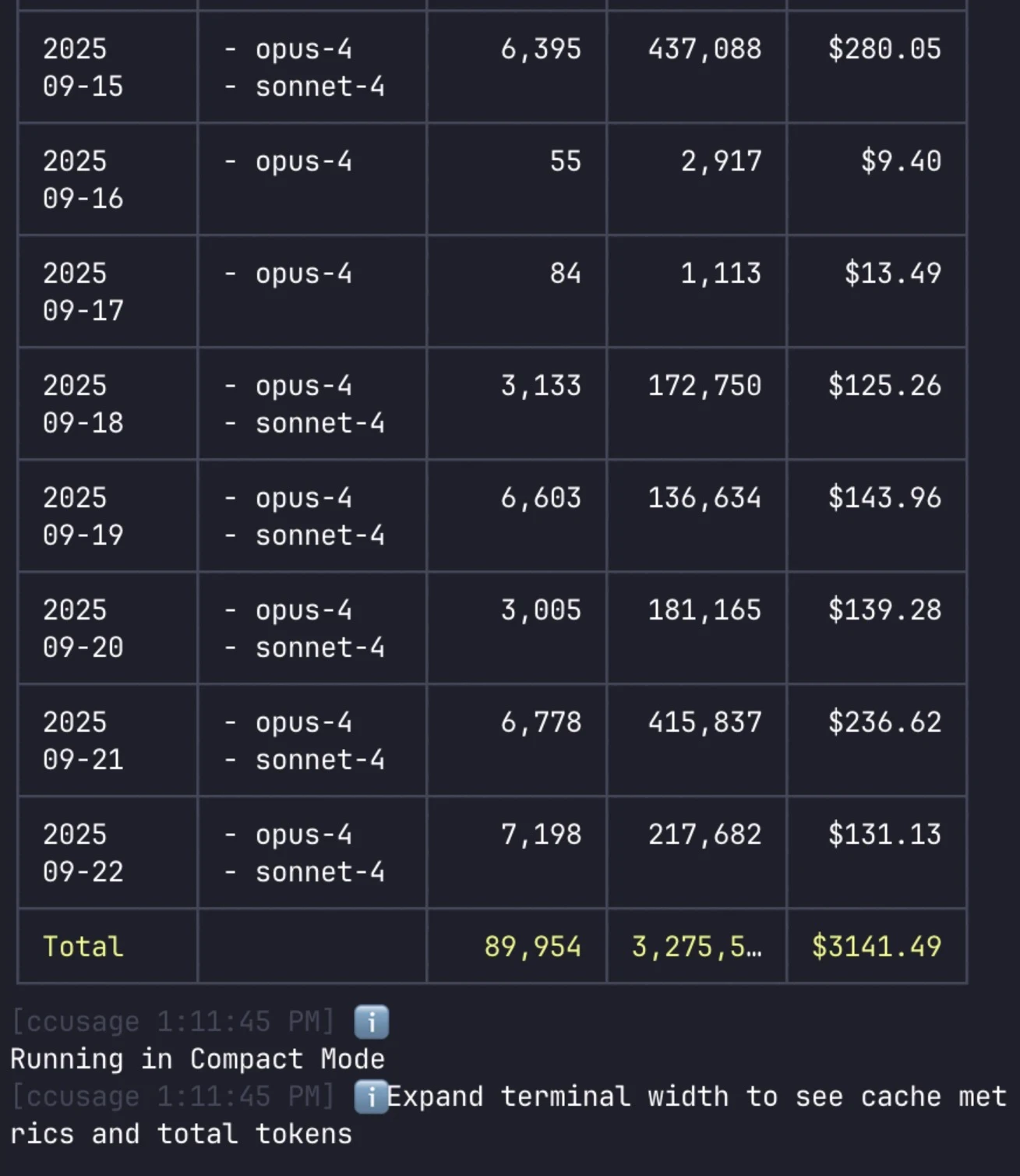
小趣闻: 2025 年 9 月,我在 Claude Code 上的用量飙到了 3000 美元

3000 美元 Claude Code 用量

原因很简单:我把 Claude Code 放进了一个 7x24 agent 循环 里帮我打理业余项目。我睡着时,循环会评估现场、派生 subagents、让事情持续推进。等我醒来,进度已经悄悄向前走了一截。

但这种魔法并不是 Claude 独有;只要你理解了配置的精髓,就能把这个魔法复刻到任何实现了相同要件的模型与 agent runtime 上。

下面就带你从头搭建。

幕后的秘密

事实是:最新的 Claude 4、GPT-5 这类大模型已经在 agent 任务 上被反复训练。它们“知道”如何评估、如何规划、如何调用工具,以及如何把控制权交还。你无需庞大的框架,只需要协议和循环。

Agent 循环的本质

为了把「协议 + 循环」具体化,先看这张最小化流程图:evaluator 决定下一步动作,派生 executor 去执行 tool,executor 回报结果,然后控制权回到 evaluator,直到目标完成。
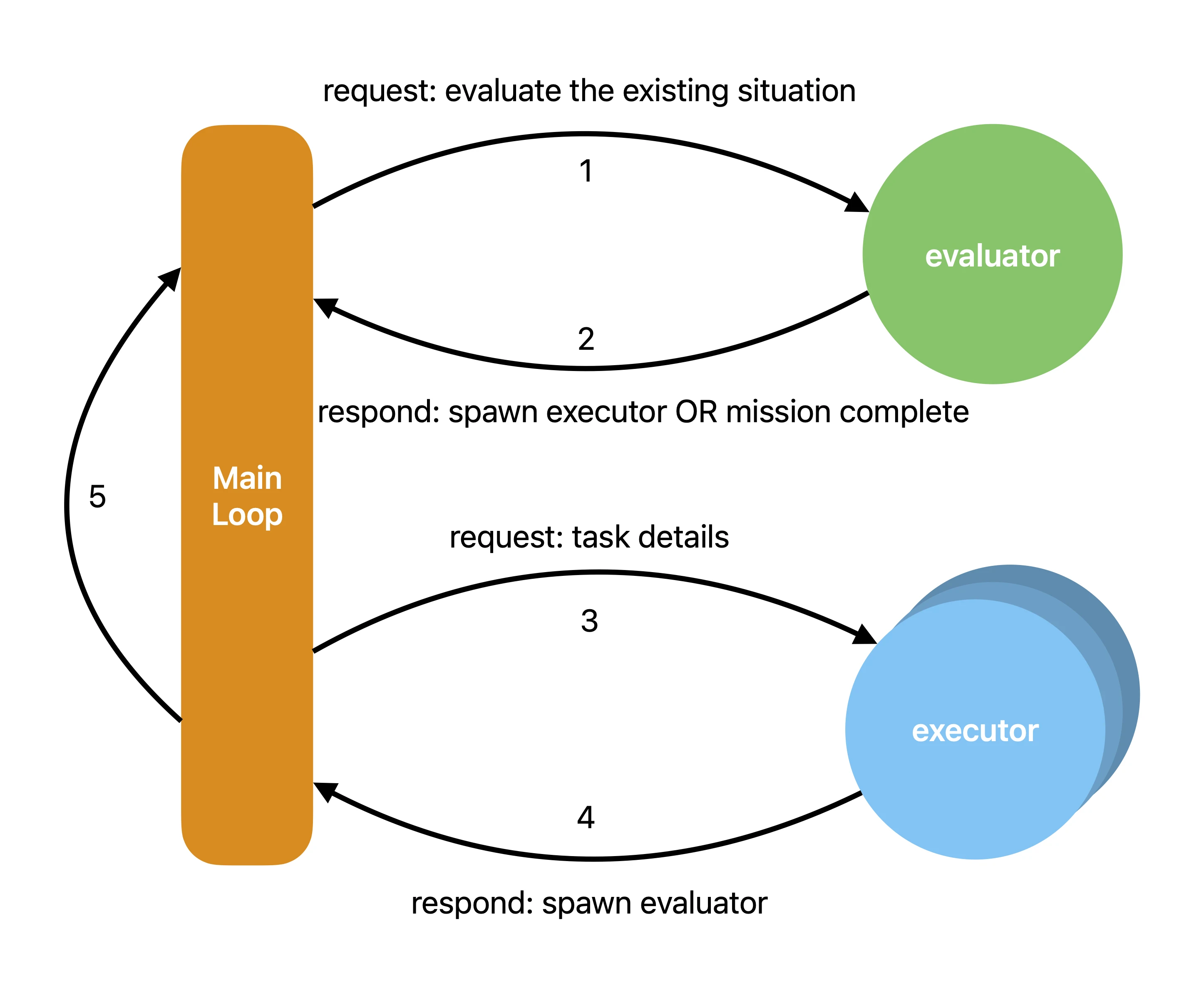
一张标题为“Main Loop”的示意图,展示了 evaluator 与 executor 在五步循环中反复互动:evaluator 请求触发 executor,executor 请求任务细节,回应再触发 executor
基础 Agent 循环

不过,要让这套流程变成可运行的系统,需要三个组件协同工作:合适的 模型、能够落实协议的 提示词,以及专为工具调用设计的 agent runtime

  1. 挑选合适的模型

    在提示词压力下仍旧严格遵守 JSON 格式;

    对角色、动作保持高度自律;

    在进行工具调用时保持理性推理,不胡乱臆测。

  2. 围绕协议写提示词

    循环的骨干是固定格式的 schema。每个 evaluator 与 executor 都必须在这份结构下作答,把原本自由的 LLM 对话收束成可预测、可解析的沟通。

  3. 支持工具调用

    没有工具调用,循环只是在自言自语;有了 CLI 命令,它就能跑测试、抓数据、修补代码或监控系统。甚至不需要内建 subagent,只要通过 bash tool 拉起外部 agent 实例,也能维持 evaluator 与 executor 的心跳。

写下你的第一份协议驱动提示词

角色和循环已经清楚,现在我们用 Claude Code 的 subagent 和 custom command,搭出一个清理仓库里 TODO/FIXME 的循环1。无需额外的 Schema 文件——协议就在提示词里。Claude 4 非常适合承担 7x24 agent 循环。

循环结构

循环包含三部分:

  • cleanup 命令
  • cleanup-evaluator subagent
  • cleanup-executor subagent
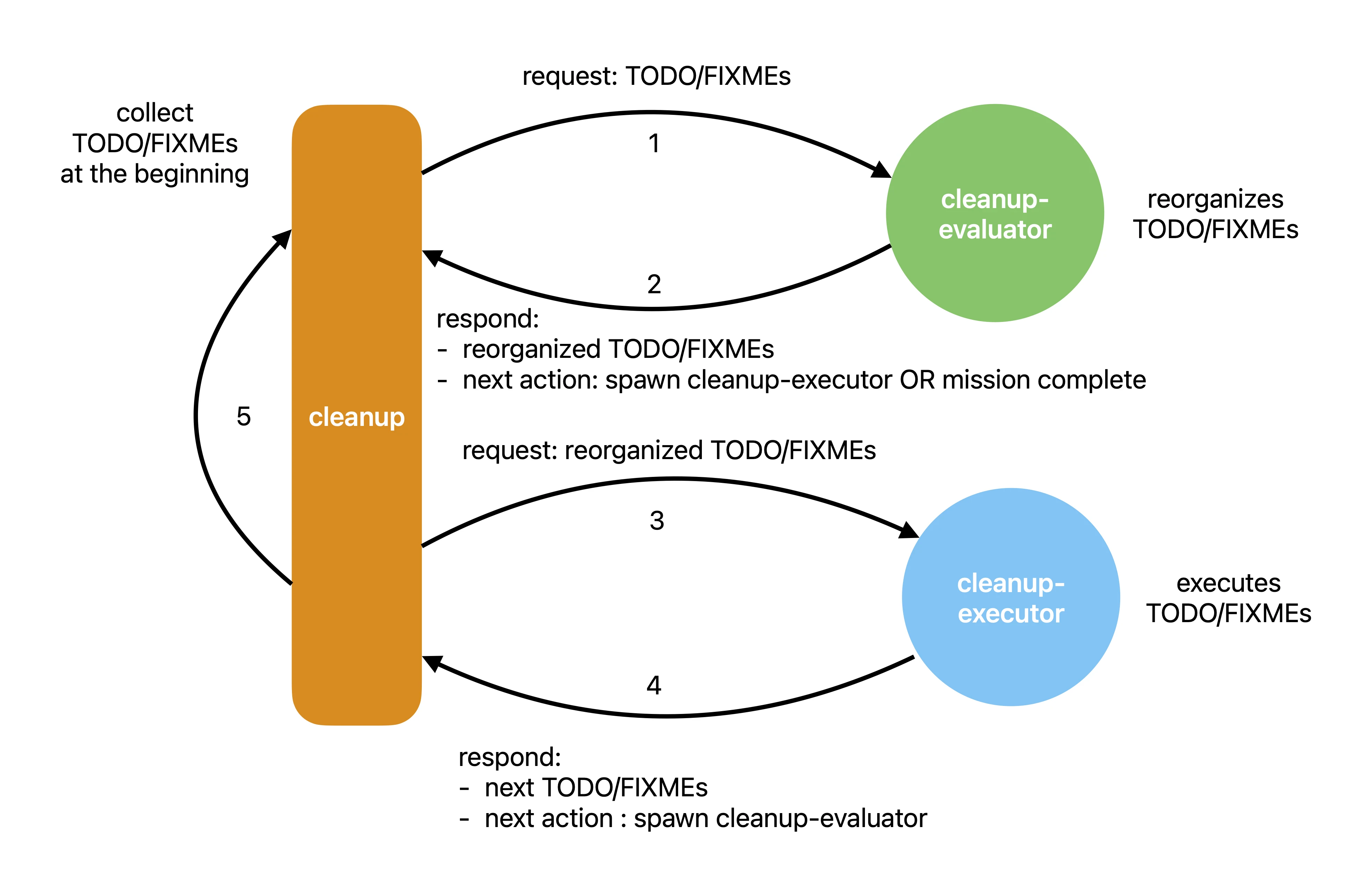
一个标题为
TODO/FIXME 循环

cleanup 命令是循环的入口,也是 main agent 所在。它会扫描仓库里的 TODO/FIXME,整理出一份工作清单,再把清单交给 cleanup-evaluator subagent。

cleanup-evaluator subagent 负责分拣并重排清单,然后把整理后的清单以及 spawn(cleanup-executor) 这个下一步动作反馈给 main agent

main agent 会按 cleanup-evaluator 的指示,拉起 cleanup-executor subagent,并把重排后的清单转交过去。

cleanup-executor subagent 会从清单中取出第一条 TODO/FIXME,执行完成后更新清单,再把更新后的清单和 spawn(cleanup-evaluator) 这一下一步动作回应给 main agent

main agent 再次依据 cleanup-executor 的回复拉起 cleanup-evaluator subagent,把最新的清单交给它,于是循环回到开头。

协议长什么样

让循环持续运转的关键,是确保 main agent 与所有 subagent 都遵守协议。好消息是,这份协议很直观。在这个例子里,每个 subagent 会收到来自 main agent 的 JSON 对象,格式如下:

json
{
"incomplete_items": [incomplete_item_list],
"completed_items": [completed_item_list],
"postponed_items": [postponed_item_list]
}

Subagent 回给 main agent 时,使用的 JSON 结构是:

json
{
"incomplete_items": [reordered_incomplete_item_list],
"completed_items": [completed_item_list],
"postponed_items": [postponed_item_list],
"next_action": "spawn(cleanup-executor)|spawn(cleanup-evaluator)|mission_complete"
}

通过工具收集 TODO/FIXME

你也许好奇 [incomplete_item_list] 是什么。你可以把它视作提示词里的“变量”:它们来自工具调用。在 cleanup 命令开头的提示词,会触发如下指令:

cleanup.md
markdown
## MANDATORY: 1. FIND DOCUMENTED TODOs and FIXMEs
You SHALL use the `grep` tool piped with `head` to find the first `10` documented TODOs and FIXMEs in the repository.
Command: grep -r -n -E "TODO|FIXME" . | head -n 10

不过原始输出不能直接拿来用。我们必须告诉 agent 期望的格式,并要求它把结果整理成符合协议的 JSON 对象。

cleanup.md
markdown
The outputs are in the following format.
```shell
[file]:[line]:[content]
```
You SHALL READ around each [line] in [file] and EXTRACT the [content] from all the found TODOs and FIXMEs, filtering out the ones cannot be applied apply with the restrictions of the platform, operating system, and required tools, then convert into a JSON object of the following format, using [incomplete_item_list] as the mnemonic:
```json
[
{
"type": "todo",
"id": "TODO_1",
"file": [todo_1_file],
"line": [todo_1_line],
"content": [todo_1_content]
},
{
"type": "todo",
"id": "TODO_2",
"file": [todo_2_file],
"line": [todo_2_line],
"content": [todo_2_content]
},
{
"type": "fixme",
"id": "FIXME_1",
"file": [fixme_1_file],
"line": [fixme_1_line],
"content": [fixme_1_content]
},
{
"type": "fixme",
"id": "FIXME_2",
"file": [fixme_2_file],
"line": [fixme_2_line],
"content": [fixme_2_content]
}
]
```
You SHALL NOTE a JSON object with and empty "items" array as [completed_item_list]:
```json
[]
```
You SHALL NOTE a JSON object with and empty "items" array as [postponed_item_list]:
```json
[]
```

用提示词强制贯彻协议

这里的协议直接写在提示词里——没有任何隐藏技巧,而是用清晰的命令一遍遍强调,直到模型完全照做。

下面这段展示了 main agent 如何在循环开始时拉起 cleanup-evaluator

cleanup.md
markdown
## MANDATORY: 2. SPAWN A CLEANUP-EVALUATOR TO EVALUATE INCOMPLETE TODOs and FIXMEs
You MUST spawn a cleanup-evaluator subagent to evaluate the gap between the incomplete TODOs and FIXMEs and the existing situation.
You SHALL ALWAYS send the cleanup-evaluator with a JSON object of the following format:
```json
{
"incomplete_items": [incomplete_item_list],
"completed_items": [completed_item_list],
"postponed_items": [postponed_item_list]
}
```

cleanup-evaluator 一侧也必须执行协议:

cleanup-evaluator.md
markdown
## MANDATORY: PARSE THE RECEIVED JSON OBJECT
YOU WILL RECEIVE a JSON object of the following format:
```json
{
"incomplete_items": [incomplete_item_list],
"completed_items": [completed_item_list],
"postponed_items": [postponed_item_list]
}
```

cleanup-evaluator 完成评估后,它会按照协议准备回给 main agent 的响应。这个例子里,next_action 只有两种:拉起 cleanup-executor,或者宣布 "mission complete"。

cleanup-evaluator.md
markdown
## MANDATORY: RESPOND TO THE MAIN AGENT
You SHALL RESPOND with the [reordered_incomplete_item_list], [completed_item_list], [postponed_item_list] to the main agent with the JSON object of the following format:
```json
{
"incomplete_items": [reordered_incomplete_item_list],
"completed_items": [completed_item_list],
"postponed_items": [postponed_item_list],
"next_action": "spawn(cleanup-executor)|mission_complete"
}
```
The `next_action` field SHALL BE `mission_complete` when NO ITEMS ARE LEFT in [reordered_incomplete_item_list].
Otherwise, the `next_action` field SHALL BE `spawn(cleanup-executor)`.

回到 main agent,它会依据 cleanup-evaluator 的反馈拉起 cleanup-executor subagent,并把三个列表传过去:

cleanup.md
markdown
## MANDATORY: 3. UNDERSTAND THE CLEANUP-EVALUATOR'S RESPONSE
The cleanup-evaluator subagent is ALWAYS the core of the workflow.
YOU MUST OBEY THE DECISION OF THE CLEANUP-EVALUATOR IN [next_action].
You SHALL NEVER CHANGE THE DECISION OF THE CLEANUP-EVALUATOR in [next_action].
The [next_action] COULD BE: `spawn(cleanup-executor)` | `mission_complete`:
The [next_action_details] COULD BE:
```json
{
"type": "todo|fixme",
"id": [next_item_id],
"file": [next_item_file],
"line": [next_item_line],
"content": [next_item_content]
}
```
OR
```json
{
"type": "mission_complete"
}
```
The cleanup-evaluator subagent SHALL NEVER know if it is the last time to evaluate until the [next_action] of a spawned cleanup-evaluator turns out to be `mission_complete`.
### MANDATORY: ALWAYS TRANSFER [incomplete_items], [completed_items], [postponed_items] FROM THE CLEANUP-EVALUATOR'S RESPONSE TO THE NEXT SUBAGENT
YOU MUST transfer the [incomplete_items], [completed_items], [postponed_items] from the cleanup-evaluator's response to the next subagent with the JSON object of the following format:
```json
{
"incomplete_items": [incomplete_item_list],
"completed_items": [completed_item_list],
"postponed_items": [postponed_item_list],
}
```

此时协议允许 main agent 拉起 cleanup-executor 来执行下一条 TODO/FIXME。不过我们还需要告诉 main agent 如何处理 cleanup-evaluator 之外的 subagent 的反馈:

cleanup.md
markdown
## MANDATORY: 4. UNDERSTAND THE RESPONSE FROM OTHER SUBAGENTS
All the subagents other than the cleanup-evaluator subagent SHALL ALWAYS respond with a JSON object of the following format:
```json
{
"incomplete_items": [next_incomplete_item_list],
"completed_items": [next_completed_item_list],
"postponed_items": [next_postponed_item_list],
"next_action": "spawn(cleanup-evaluator)",
}
```
### MANDATORY: ALWAYS READ Subagent’s Response to Decide Next Action
The [next_action] is ALWAYS to spawn a cleanup-evaluator subagent.
You MUST SEND the cleanup-evaluator a JSON object of the following format:
```json
{
"incomplete_items": [next_incomplete_item_list],
"completed_items": [next_completed_item_list],
"postponed_items": [next_postponed_item_list],
}
```

最后,让 main agent 知道何时应该收尾:

cleanup.md
markdown
## MANDATORY: 5. HANDLING MISSION COMPLETE
If `next_action` in the response from the cleanup-evaluator subagent is `mission_complete`, then the mission is completed.
You SHALL STOP ALL THE SUBAGENTS AND EXIT THE WORKFLOW.

到这里,我们已经用整套协议驱动的提示词搭好了第一个 agent 循环。

试一试

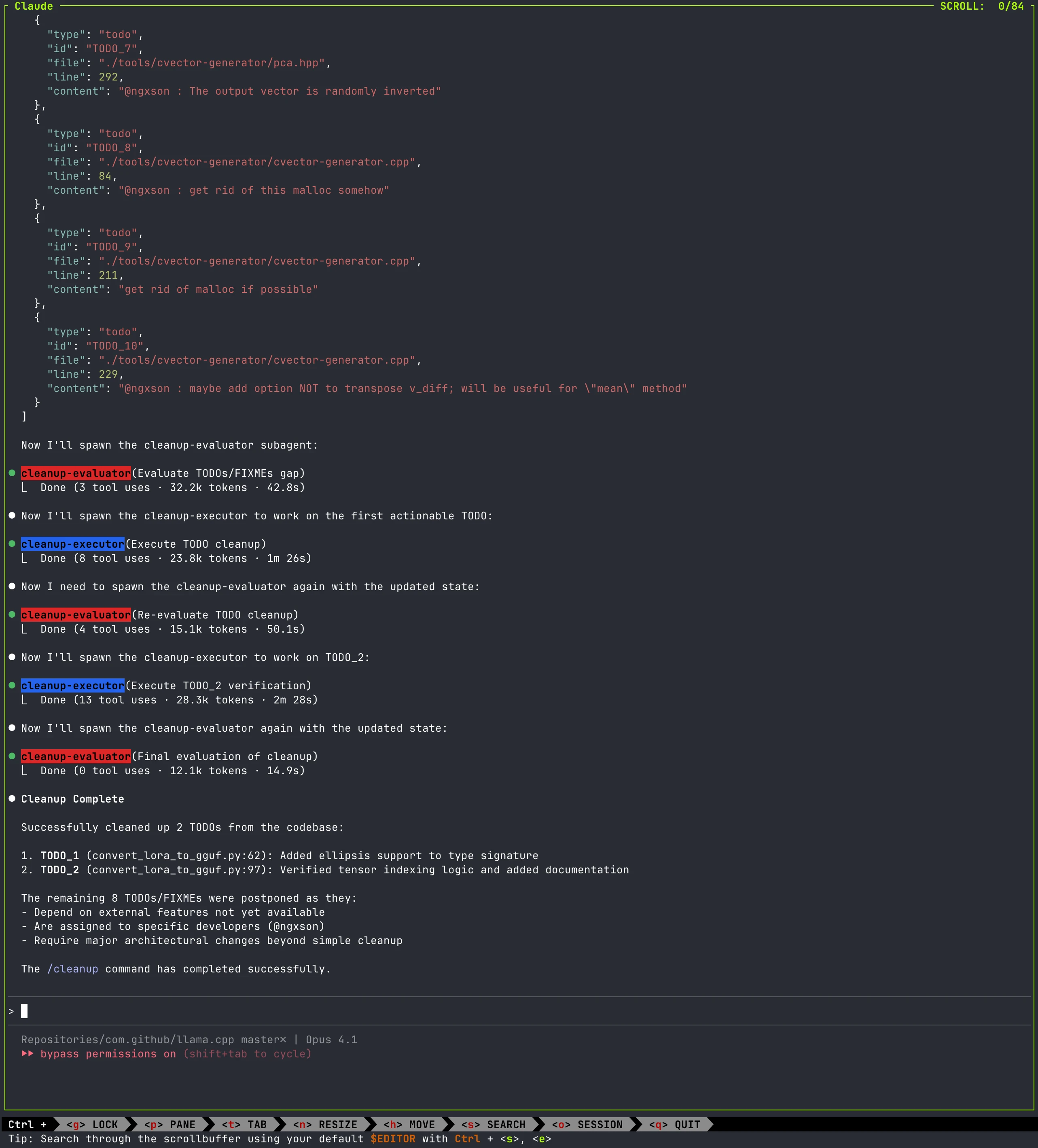
当你把这个循环跑在 llama.cpp 项目上时,会发生以下情况:循环会精确处理 10 条 TODO 和 FIXME 后结束——无需宏大目标,只需一次专注的清理循环,就能让核心机制完整跑通。
试一试
试一试

让循环 7x24 运作

要让循环全天候运行,重点是持续供给“饲料”,而不仅仅是持续时间。循环靠把 A 持续变成 B 活下去:把一种产出不断转换成另一种。假如 A 是点子、B 是程序(或修复、测试、发布),那么想要 7x24 地运转,就需要源源不断的点子。

现实里,我们不可能拥有无限点子。更实际的做法是:让循环承担足够大、值得托付的工作,为你腾出思考时间。当 agent 在完成 A→B(例如编译、测试、打包、部署)时,你就能利用空档决定下一个 A。像 TODO/FIXME 扫描器或 issue 跟踪器这样的“饲料器”可以提供候选项,但无法代替你的判断。循环负责落实有意义的任务,你负责策展输入,这就是维持 7x24 节奏的正确姿势。

不止 Claude Code

你也许会问:如果我不用 Claude Code,而是用 Codex 呢?答案很简单:流程不变。这个循环和 agent 厂商无关,它只靠三样东西:协议、循环、agent runtime。换句话说,evaluator 决定下一步,executor 负责执行,main agent 负责路由和护栏,其余都是实现细节。

Claude Code 的优势在于提供了两个顺手的原语:

  • Subagent:带有提示词和角色的轻量 agent 实例。
  • Custom command:触手可及的携带提示词和工具调用的命令块。

但它们都不是必需的。你可以替换成:

  • 用工具调用拉起其他 AI agent 用取代 subagent(例如执行 CLI,启动新的 agent 并返回结构化结果);
  • 用 shell 脚本向 AI agent 发送自定义提示词,取代 custom command。

只要协议和循环仍在,执行机制就能自由互换。Main agent 负责路由、约束模式,并让循环持续运转,直到 next_action 变成 mission_complete

对比 LangChain 与 LangGraph

你可能还在想:为什么不用 LangChain 或 LangGraph?下面这张表能更清楚地说明取舍。

考虑点
Agent Runtime
LangChain 或者 LangGraph
要求
合适的模型
SDK + 工具 + 记忆抽象层
配置
提示词
链或者图
工具调用
通过提示词调用
通过提示词及系统级适配层

这张对比表呈现了本文所述 agent runtime 路线,与 LangChain 或 LangGraph 框架之间的差异:搭建循环需要什么、如何搭建、以及如何进行工具调用。

从表格可见,agent runtime 这条路线更轻量,依靠原生工具就能融入任意技术栈,同时保持对 agent 厂商的中立,让人掌控输入,而循环本身则可以 7x24 地产出成果。

总结

要打造一个 7x24 的循环,你并不需要 LangChain 或 LangGraph。真正需要的是:

  • 一个在 agent 任务上经过训练的模型;
  • 由提示词严格执行的协议;
  • 支持工具调用的 agent runtime。

具备这些条件,就能让 Claude Code(或 Codex)在循环里持续工作,即便你已经入睡。

今晚就动手试试看吧。明早醒来,也许成果已经在等你。