Using an Opus 5.5 Subagent With Opus 4.6 as the Main Agent
Yesterday I shared a post on X showing how a Claude Opus 4.6 main agent paired with a Claude Opus 5.5 subagent creates a classic Confused Deputy problem in multi-agent systems. Readers in the replies asked a practical question: how do you spawn an Opus 5.5 subagent when your main Claude Code session runs on Opus 4.6?
Ask the main agent to spawn claude-opus-5-5 on the fly in a prompt, and you hit a wall. Anthropic has tightened model selection across Claude Code's Agent tool and context forking. Today, the only reliable way to run an Opus 5.5 subagent under an Opus 4.6 main agent is to define a custom subagent in .claude/agents/ and pin its model field to the Model ID claude-opus-5-5.
Model Name, Model Alias, and Model ID
Claude Code's documentation distinguishes three terms that developers often conflate:
Term | Purpose | Examples | Accepted in model Config? |
|---|---|---|---|
Model Name | Human-readable product title shown in menus and documentation. | Claude Opus 5.5, Claude Opus 4.6 | No |
Model Alias | Dynamic shorthand that resolves to the latest default release in a tier. | opus, sonnet, haiku, fable | Yes (tracks latest version) |
Model ID | Immutable backend identifier pinned to one model snapshot. | claude-opus-5-5, claude-opus-4-6 | Yes (in session flags and subagent frontmatter) |
- A Model Name is for humans alone: Configuration files and CLI flags reject
Claude Opus 5.5because the API expects a machine-readable identifier. - A Model Alias is a moving target:
opusresolves to whichever Opus generation Claude Code sets as the default, so a single alias cannot pin two generations of the same family side by side. - A Model ID pins a specific generation: Passing
claude-opus-4-6to the main session andclaude-opus-5-5to a custom subagent locks each layer to an exact model snapshot.
The Only Working Setup: A Predefined Custom Subagent
Claude Code stores custom subagents as Markdown files with YAML frontmatter in .claude/agents/ (for one repository) or ~/.claude/agents/ (across all projects). Unlike ad-hoc Agent tool calls, the model field in subagent frontmatter accepts a full Model ID.
Step 1: Define the opus-55 Subagent
Create .claude/agents/opus-55.md (or ~/.claude/agents/opus-55.md) and set model to claude-opus-5-5:
markdown
- The
namefield registers a named subagent type: A named agent lets the main session bypass generic context forking and dispatch work directly toopus-55. - The
modelfield pins the exact Model ID:model: claude-opus-5-5overrides the parent session'sclaude-opus-4-6model wheneveropus-55starts.
Step 2: Launch the Main Session on Opus 4.6
Start Claude Code with the main session pinned to claude-opus-4-6:
bash
Inside an existing interactive session, /model claude-opus-4-6 switches the main model in place.
Step 3: Delegate Work to the Predefined Subagent
From your claude-opus-4-6 session, instruct the main agent to delegate the task to opus-55:
text
When Claude Code invokes opus-55, the main coordinator stays on claude-opus-4-6 while the subagent runs inside a fresh, isolated claude-opus-5-5 context window.
Why Every Other Workaround Fails (Verified on Claude Code v2.1.325)
Earlier versions of Claude Code let the built-in Agent tool switch models freely on the fly. Today, Claude Code blocks every zero-file workaround, including environment-variable alias overrides, or routes it back to the main agent's Opus model (Opus 4.6 in our example):
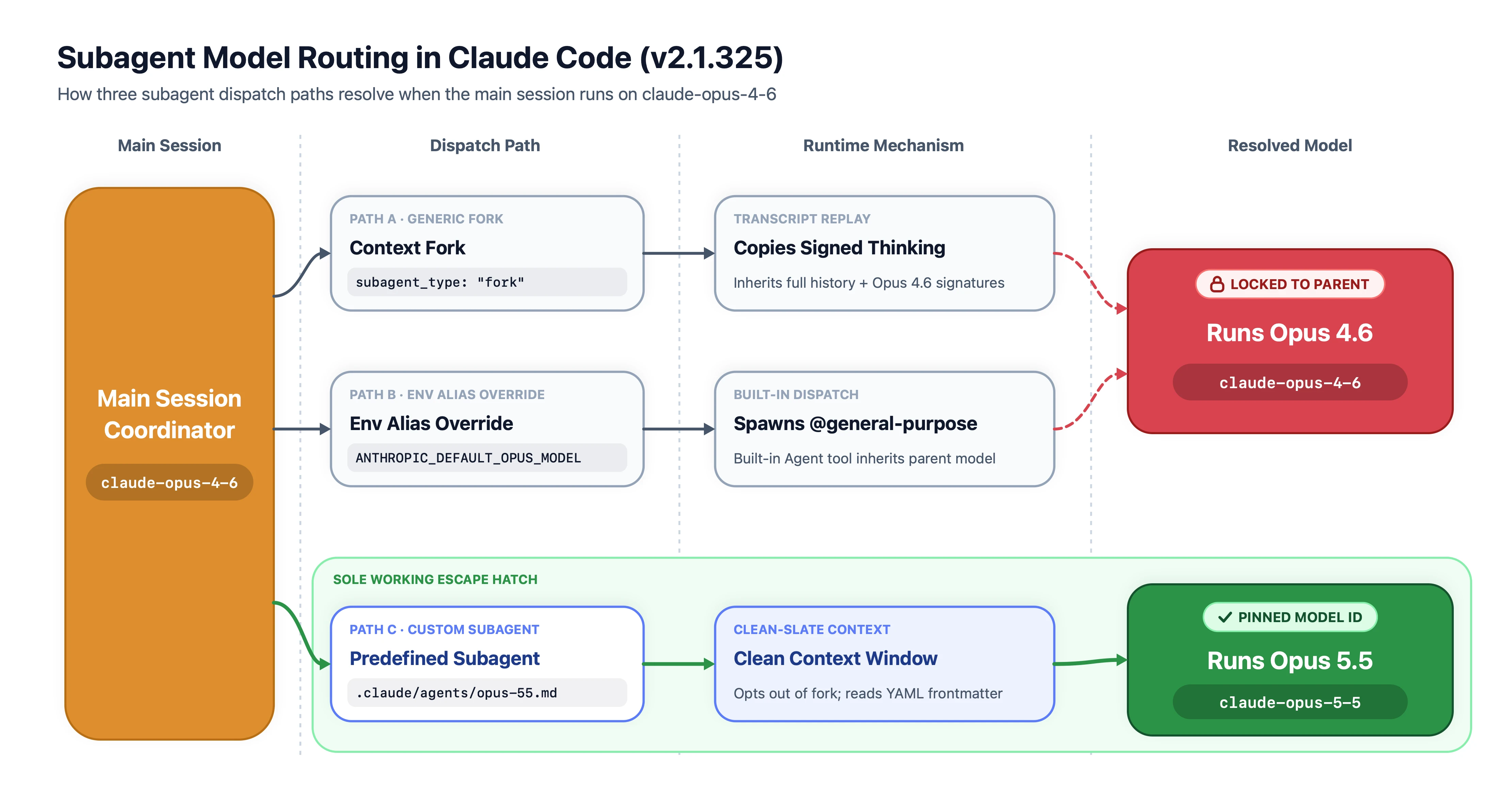
- Prompting the
Agenttool with a raw Model ID fails: Claude Code restricts per-invocationmodelparameters on the built-inAgenttool and blocks the calling LLM from passing versioned Model IDs such asclaude-opus-5-5at runtime. - Pinning the
opusalias through environment variables fails: A tempting workaround launches Claude Code withANTHROPIC_DEFAULT_OPUS_MODEL="claude-opus-5-5"(even paired withCLAUDE_CODE_SUBAGENT_MODEL="claude-opus-5-5"andCLAUDE_CODE_FORK_SUBAGENT=0), switches the main session to/model claude-opus-4-6, and asks theAgenttool to spawn anopussubagent. - Built-in subagents still inherit Opus 4.6: On Claude Code
v2.1.325, asking theAgenttool to spawn anopussubagent dispatches to@general-purposeand runs on Opus 4.6 (Agent(...) Opus 4.6), ignoring theopusalias override. - Generic subagent forks lock the parent model: When Claude Code forks the main agent's context (
subagent_type: "fork"), the child agent inherits the full conversation history and stays locked toclaude-opus-4-6. - Named custom subagents remain the only escape hatch: Invoking a predefined subagent from
.claude/agents/opens a clean context window and readsmodel: claude-opus-5-5straight from frontmatter, bypassing both the fork lock and built-inAgentinheritance.
Why Anthropic Locked Forked Contexts to the Same Model
Anthropic locks every forked context to its parent model—even within the Opus family—for two reasons: one cryptographic, one economic.
- Cryptographic thinking-block signatures block cross-model replay (Anti-Distillation): On frontier models such as Claude Opus 5.5, Anthropic omits raw chain-of-thought text by default (
display: "omitted") and binds each thinking block to an encrypted cryptographicsignatureto block chain-of-thought extraction, distillation, and cross-session replay. - Cross-model forks break signature verification: A forked subagent copies the parent conversation's signed thinking blocks verbatim; replaying Opus 4.6's thinking blocks into Opus 5.5—or forking an Opus 5.5 transcript into another model—fails model-bound signature checks and returns
400 Invalid signature in thinking blockfrom the Messages API. - Prompt caching demands an exact per-model prefix match (Token Economics): Anthropic scopes its prompt cache per model and matches prefixes byte for byte, so switching models on a forked full-history session invalidates the cached transcript and re-bills every historical token from scratch.
How Clean-Context Delegation Creates the Confused Deputy
The exact mechanism that makes this setup work—opting out of context forking into a fresh subagent window—also explains why pairing an Opus 4.6 main agent with an Opus 5.5 subagent creates a Confused Deputy:
- Direct prompts expose the full intent to Opus 5.5: In a standalone
claude-opus-5-5session, dual-use security or reverse-engineering prompts keep the user's high-level goal and low-level technical steps inside one context window, where Opus 5.5's stricter safeguards evaluate the full trajectory and block the request. - Subagent delegation strips away upstream intent: When a
claude-opus-4-6main session accepts the user's request and delegates a scoped technical subtask toopus-55, the predefined subagent starts with a clean slate and sees only a neutral, self-contained engineering prompt—never the upstream conversation that motivated it.
That is a textbook Confused Deputy in multi-agent systems. By locking full-history forks to the parent model while routing custom subagents into isolated context windows, Claude Code prevents cross-model thinking extraction—yet creates a clean context boundary that strips away the upstream intent signals single-session safeguards depend on.